On-Demand Virtual Visits
No Appointment Necessary.
About On-Demand Visits
On-demand virtual visits are telehealth appointments available on a first come, first serve basis providing access to experienced, specialty-trained NPs and PAs under the supervision of board-certified Gastroenterologists who can order labs, imaging, procedures, and prescriptions.
On-demand visits are available:
Monday-Friday 8am-4pm MST.
Key Benefits Include:
Rapid access to high quality care.
Connect instantly with a GI provider via video - no appointment needed. Click “Start Visit” to register.
Continuity of care with your specialist.
Providers treat most common GI symptoms and provide comprehensive care just like an office visit.
No travel or waiting room time.
Wait times are typically under 30 minutes. Because this is an immediate-access service, you will see the first available clinician rather than a specific provider.
FAQs
Connect instantly with a GI provider via video - no appointment needed.
Click “Start Visit” to register. We’ll text and email you when your provider is ready so you don't need to wait by the screen. Register anytime; if the clinic is closed you’ll be able to join the queue when we open. Hours: Mon–Fri 8 AM – 4 PM MST
Available for insured patients aged 18+. Visits are billed as standard office appointments. Cash- pay patients: please call (208) 343-6458 to schedule an in-office visit.
Providers treat most common GI symptoms and can order labs, imaging, procedures, and prescriptions. Note: These visits are not for medical emergencies. If you are experiencing an emergency, please call 911 or go to the nearest ER.
Wait times are typically under 30 minutes. Because this is an immediate-access service, you will see the first available clinician rather than a specific provider.
You can use a smartphone, tablet, or computer. You just need a stable internet connection, a working camera/microphone, and an updated web browser.
No special app is required.
Troubleshooting: If you cannot connect, try a different device. If issues persist, please call the office at (208) 343-6458.
Yes. Our platform is HIPAA-compliant and fully encrypted to protect your privacy and data.
Colon Cancer Screening
FastTrack Colonoscopy

Idaho Gastro’s Fast Track Colonoscopy program makes colon cancer screening easy:
- Digital intake to confirm eligibility
- No extra office visit required for most patients
- Quick scheduling to get you tested sooner
Note: Not every patient will be eligible for the Fast Track program — we’ll guide you through a short intake to determine the right option for you.
The Fastest, Easiest Way to Schedule Your Screening Colonoscopy:
If you’re between ages 45 and 75, it’s time for colorectal cancer screening—even if you feel healthy and have no symptoms.
What is colon cancer screening?
Colon cancer screening is a routine test that helps find colon cancer early — often before symptoms start — and can even prevent cancer by detecting and removing precancerous growths called polyps.
This screening is most commonly done using a colonoscopy, which allows direct visual examination of the entire colon.


Who should be screened?
- Most adults between ages 45 and 75 should undergo regular colorectal cancer screening — even if they feel healthy and have no symptoms.
- Screening may start earlier or more often for people with a family history of colon cancer, personal history of polyps, or other risk factors.

Why is screening important?
Colon cancer frequently develops without early symptoms, which is why routine screening is essential. Screening can:
- Detect colon cancer early, when treatment is most effective.
- Prevent cancer by identifying and removing precancerous polyps before they become cancerous.
- Reduce mortality and improve long-term outcomes.
Common Screening Methods
There are several screening options available.
While some are non-invasive, colonoscopy remains the most effective screening test because it can both detect and remove precancerous polyps in the same procedure.
Your provider can help you choose the option that is right for you.
Let's take a look at four testing options:
- Colonoscopy
- Flexible Sigmoidoscopy
- Stool DNA Test
- FIT Test (Fecal Immunochemical Test)

Colonoscopy (Gold Standard)
A colonoscopy is considered the gold standard for colon cancer screening.
During the procedure, a gastroenterologist uses a thin, flexible camera to examine the entire colon. If polyps (small growths that can turn into cancer) are found, they can be removed immediately during the same procedure.
Why colonoscopy is the most effective screening option:
- Examines the entire colon
- Detects cancer and precancerous polyps
- Polyps can be removed during the procedure
- Only needed every 10 years for most average-risk patients
- Prevents cancer, not just detects it
- Because it both finds and removes precancerous polyps, colonoscopy is the most powerful tool we have to prevent colorectal cancer.

Flexible Sigmoidoscopy
A flexible sigmoidoscopy is a screening procedure that allows a provider to examine the lower portion of the colon (rectum and sigmoid colon) using a thin, flexible camera.
Because it only evaluates part of the colon, it can detect polyps or cancer in the lower third of the colon, but it does not examine the entire colon.
Things to know:
- Examines the lower part of the colon only
- Typically recommended every 5 years
- Usually requires less preparation than a colonoscopy
- Often done without sedation
- Polyps found may still require a follow-up colonoscopy
- Because flexible sigmoidoscopy does not evaluate the entire colon, cancers or polyps in the upper portions of the colon may be missed.

Stool DNA Test (Cologuard®)
A stool DNA test (commonly known as Cologuard®) is a non-invasive screening test that looks for DNA markers and blood in the stool that may indicate cancer or advanced polyps. The test is completed at home and mailed to a lab for analysis.
Things to know:
- Done at home
- Recommended every 3 years if results are normal
- Looks for DNA changes linked to colorectal cancer
- If the test result is positive, a follow-up colonoscopy is required to determine the cause.
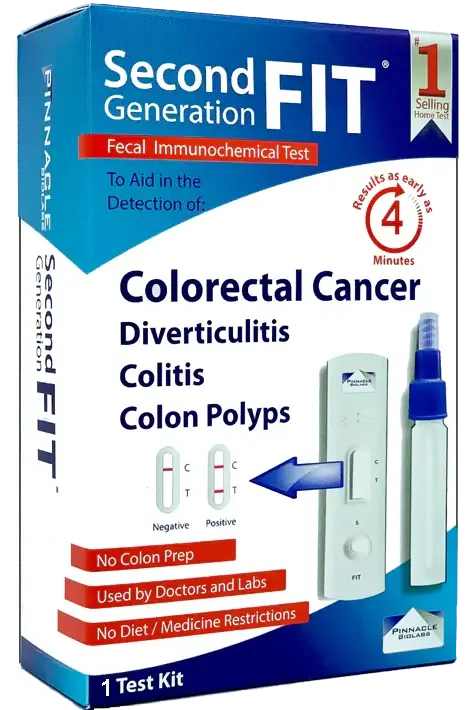
FIT Test (Fecal Immunochemical Test)
The FIT test checks for hidden blood in the stool, which can be a sign of colorectal cancer. This test is also completed at home and returned to a lab for analysis.
Things to know:
- Non-invasive at-home test
- Must be done every year
- Detects hidden blood in stool
- Less sensitive at detecting cancer and precancerous polyps
- Studies show FIT tests detect about 70–75% of colorectal cancers, which means cancers and polyps may still be missed.
- As with other stool-based tests, a positive FIT result requires a follow-up colonoscopy.